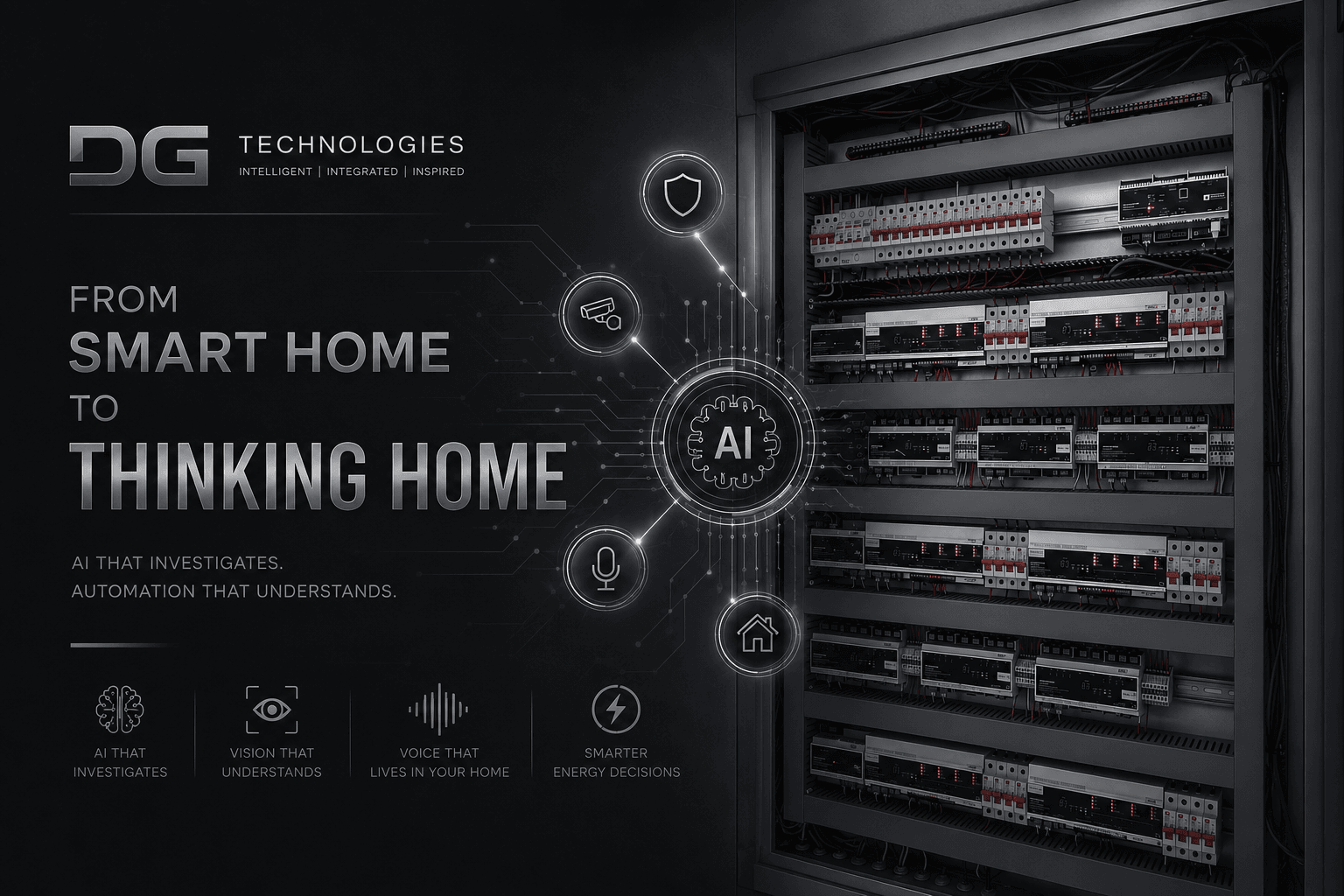
For years, home automation has been built around triggers.
If motion is detected, turn on a light. If it is sunset, close the blinds. If the gate opens, send a notification. If the schedule says the pool pump must run, switch it on.
It works. But it has a quiet weakness: most automation does not understand what is happening. It only knows that a condition was met.
A camera sees movement, but it does not know whether that movement was a person, a dog, a shadow, rain, or an insect crossing the lens at 2am. A schedule knows it is time to start the pool pump, but it does not know whether the pool area looks normal. A geyser timer knows the hour, but it knows nothing about the weather, recent usage, or whether the house is already close to its electrical limit.
This is where AI becomes genuinely interesting. Not as a gimmick. Not as another voice assistant that turns lights on and off. As a reasoning layer.
Traditional automation reacts. AI-assisted automation investigates.
Why context changes the result
Here is the difference in one scenario.
A camera detects a line-crossing event at night. In a traditional system, that immediately becomes an alarm, a notification, and possibly a call to the security company, regardless of what actually crossed the line.
In an AI-assisted system, that trigger becomes the start of an investigation. The AI checks the camera. It looks at the actual image. Is there a person near the gate? A pet? A branch in the wind? Rain on the lens? Does the gate appear open? Are the lights already on? Is this normal for this time of night?
Only after that context check does it decide what to do. It might switch on selected lights so the house looks awake. It might verify the gate is closed. It might check a second camera angle for confirmation. It might send a genuinely useful alert, such as “possible person near the driveway”, with a snapshot attached. Or it might do nothing at all, because the cause was harmless and nobody needs to be woken up.
That last part matters more than it sounds. False alarms are not just irritating. They train people to ignore alerts, they waste armed response callouts, and they slowly erode trust in the very system meant to make a home feel safer. A home that can reason before reacting cuts through that noise.
This is especially relevant in South African homes where CCTV and security systems, gate automation, estate access, lighting and backup power all need to work together.
What we are actually building
This is not only a concept piece. DG Technologies has been researching and building the next layer above traditional automation.
Underneath everything sits proper, deterministic automation: the discipline our industry is built on. Loads are mapped cleanly, areas are defined, and the system state is queried before anything is claimed or changed. On top of that, the AI gets a carefully controlled set of tools: find a device, switch a load, control a whole area, inspect cameras, check gate safety, read live weather and forecasts, and report on system state.
It does not get unlimited authority. It gets defined capabilities, and nothing else.
The most captivating part is the voice layer. The assistant can run as a live, real-time voice system: listening through the home, speaking back through the home audio, and becoming the living voice of the home itself.
Ask it, “what is on in the cellar?” and it resolves that natural phrase into a mapped area, checks live status, and answers in plain language. Ask, “will it rain later?” and it checks an actual forecast rather than guessing. When a camera wakes it, it captures an image, asks vision what is really visible, and describes the scene with personality, but never with fiction.
That is the rule we hold sacred: the AI is allowed to think, but never allowed to hallucinate control. If it says a light is on, that must come from system state. If it comments on a camera, that must come from a real image. Character sits on top of discipline, never in place of it.
For this reason, AI belongs on top of a properly designed home automation installation, not as a shortcut around good design, cabling, networking and commissioning.
Where this goes next
Once a home can perceive, reason and act, the possibilities compound quickly.
At sundown, it can run a quiet security pass: confirming gates are closed, checking exterior lights and cameras, then settling the property into night mode. It can be designed to avoid unsafe decisions, such as closing a gate without checking context first.
With geysers, pool pumps and other heavy loads, it stops being a dumb timer. The system can consider when the water was last heated, the outside temperature, how long a 200-litre tank takes to cool, the current draw on the mains, and the headroom left on the main breaker. A house that knows it is feeding off a 62-amp breaker and is already close to that limit should hesitate before switching on another heavy load.
That is where AI becomes practical rather than decorative. It can help make smarter energy decisions, reduce nuisance alerts, and make complex properties easier to manage.
And then there is the part that still feels like science fiction, except it is not: your house messaging you.
Not a generic push notification. An actual message from your home, telling you it spotted something unusual, attaching a snapshot of what it saw, explaining what it already did about it, and asking whether you would like it to do anything more. A home that phones home. On your behalf, it can make the small decisions, and it knows which decisions are not its to make.
The platform still matters
AI does not replace the control system. It makes the control system more useful.
That distinction is important. A serious smart home still needs stable infrastructure, labelled circuits, reliable networking, correctly planned loads, secure access, clean programming and supportable documentation. AI cannot fix a badly designed electrical layout or a weak network. It can only reason from the information and control paths it has been given.
That is why DG Technologies continues to build around professional home automation foundations such as Crestron Home, proper lighting control, strong network infrastructure, well-designed CCTV and long-term support.
The best AI home systems will combine three things:
- Reliable automation underneath
- Real-time awareness of devices, cameras, weather and power
- A conversational layer that understands intent rather than syntax
The future of home automation is not a house that obeys more voice commands. It is a house that pauses for a second and asks, “What is actually happening here?” and then does the right thing.
Less remote control. More relationship.
DG Technologies designs and installs intelligent automation systems across Durban and KZN. If you would like your home to start thinking for itself, get in touch.